
Valuation Report: South Africa White Sharks 2.0
SPECIAL THANKS
Endangered Wildlife OÜ and Shark Allies would like to thank Chris Fallows and Dr Enrico Gennari for guidance.
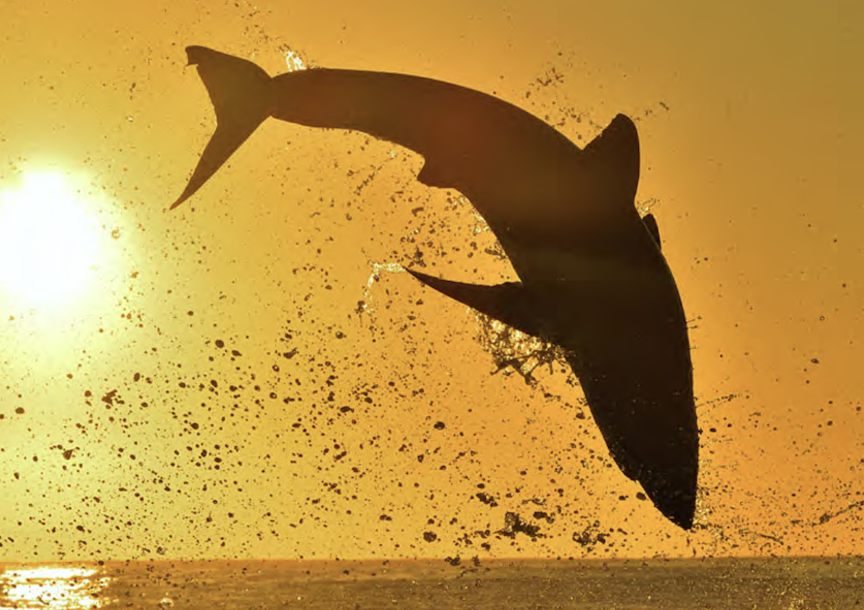
financial value dropped from US$341.7 million to ZERo
Due to the devastation of the white shark population over the past 10-15 years, we created an update in 2025. The 2022 valuation was based on data that was available at the time, ranging from 2000 to 2020. The 2025 report reflects the unfortunate current situation resulting from mismanagement, and new data based on the downward trend in population numbers since 2015, and the resulting collapse of the shark tourism industry.
Overview
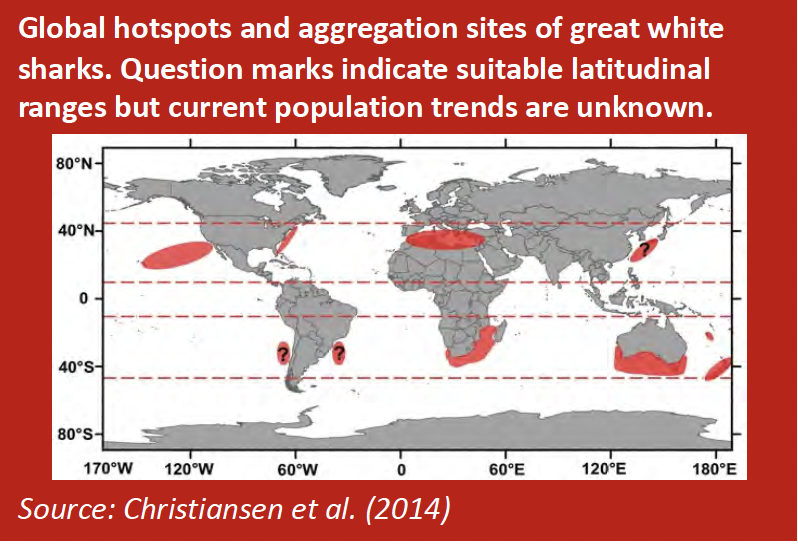
Globally, the white shark, Carcharodon carcharias, population is Vulnerable and decreasing according to the IUCN (based on the last assessment in 2018). While exact population numbers are unknown, estimates rangefrom as low as 3,000 individuals to as high as 10,00 individuals. In South Africa, the population is likely to be less than 250, compared to the 2015 maximum potential range of 500-1,000 individuals.
Unfortunately for the great white shark (also known as the white shark), it became an iconic villain on the big screen, which ignited white shark trophy hunting and reinforced galeophobia (the intense, irrational, and persistent fear of sharks). However, the number of unprovoked great white shark attacks annually is minor in comparison to other causes of death, considering the proportionate number of surfers and swimmers in the ocean. The species has therefore been disproportionately targeted and removed from oceans that depend on them on an ecosystem and trophic level. According to the IUCN, these include:
Playing an important role as facultative scavengers, consuming dead whale carcasses, thereby accessing food resources without causing additional prey death or exerting unnecessary energy catching prey.
Supporting and maintaining the stability of food webs as a vital apex predator.
Being a source of nutrients – through excretion and egestion, they facilitate rapid nutrient turnover – as well as being a store of nutrients – through the sequestration of nutrients in body tissues.
Transporting nutrients vertically from the mesopelagic to the euphotic zone, and from productive coastal areas to nutrient-poor open ocean habitats.
But fisheries using longlines, setlines, gillnets, trawls, hand-held rod and reel, and fish-traps, and beach protection programmes that use drum-lines and gillnets have depleted the populations and placed delicate ecosystems at risk.
The South Africa Situation:
While the South African population was assessed as functional and viable in 2021 by the IUCN, subsequent events indicate that the concerns raised by Andreotti et al (2016) over the state and abundance of the population have been realised. The authors had indicated that there remain only 438 individuals, of which only 333 were viable for breeding.
This has had implications for South Africa’s marine ecosystem and a once-thriving shark diving industry. Great white shark diving was one of South Africa’s fastest-growing tourism niches. Since the 1990’s, it had attracted a large number of shark-related tourists due to factors such as competitive pricing. Within the Western Cape alone, the number of shark-related tourists rose from c.a. 20,000 in 2000 to 100,000 in 2019.
This industry at the time was served by 12 operatorswho directly employ over 250 employees and who support over 1,600 dependents. It had been suggested that, in 2019, shark tourism contributed to c.a. ZAR 1bn to the country’s GDP. However, the complete disappearance of the great white sharks has caused a complete transformation of the industry. The operators have had to refocus diving tours towards other sharks, such as the bronze whaler (Carcharhinus brachyurus), with the lack of great white shark sightings in False Bay and Gansbaai, and a few, irregular sightings in Mossel Bay.
While it’s known that the South African white sharks are disappearing, the exact cause is still under debate. There are sensationalised theories, but the more common consensus is that it is due to anthropogenic reasons.
Recap on 2022 Valuation Report
At the time of the 2022 Valuation Report, there was a heated debate going on about both the status of the great white shark population and the reason for the visible decline in the population numbers. These reasons ranged from natural causes to human-induced causes.
Predatory Threat: Orcas
Since 2017, there have been numerous great white shark carcasses that have been found and identified as having fallen prey to orcas (Orcinus orca), especially around False Bay and Gansbaai. As such, there was a publicised misconception that orcas are to blame for the eradication of the white shark population. It was believed, though, that the orcas began targeting the great white sharks due to the significant drop in the number of pelagic sharks due to overfishing. While the orcas may have contributed to some white shark deaths, it remains unlikely that only two orcas are the main cause for the disappearance of great white sharks. From 2017 to 2025, there have only been a total of 11 documented occurrences of great white shark mortality as a result of orca predation.
Instead, the most likely cause of the loss of abundance is anthropogenic.
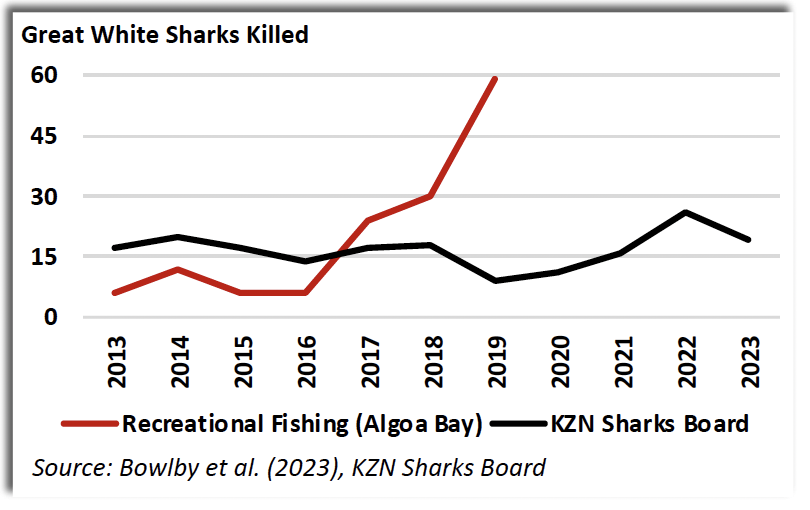
Between 2000 and 2023, the authors estimate that the KwaZulu Natal Sharks Board (KZNSB) and Demersal Shark Longline (DSL) accounted for 20 and 22 annual great white shark mortalities, respectively. The extraction of 5-10% of the population annually for more than two decades is unsustainable, especially considering the specific traits and life histories of the species.
These shark death numbers could be even higher, considering that, between 1978 and 2018, the KZNSB caught 1,317 great white sharks in nets and drumlines, of which 1,108 were dead on capture (an annual average of 28). Likewise, a DSL whistleblower indicated that most great white sharks caught are killed and discarded at sea without being reported, and that three were caught in nine weeks. Assuming that an average of four DSL vessels operate for 30 weeks per year, the implied number of white sharks killed annually is over 40.
Shark Nets and Bycatch
Shark nets and bycatch have been one of the main causes of the decline of the local great white shark population. Even though great white sharks have been protected in South Africa since 1991, they continued to be caught in high numbers as a bycatch and in shark nets.
Overfishing of Key Prey
There has been overfishing of the main prey species of the great white shark, including the dusky (Carcharhinus obscurus), soupfin (Galeorhinus galeus), and smooth hound (Mustelus mustelus) sharks. Some studies showed that the smaller sharks represent approximately 60% of the diet of the great white shark for over 75% of their lives. This indicates the importance of small sharks as prey and emphasises the threat of overfishing and stock declines to the great white shark.
Spilled Black Gold
Algoa Bay in South Africa is globally recognized as a rich biodiversity hotspot, supporting a wide range of species, including sharks, whales, dolphins, seals, penguins, and many other seabirds. However, between 2016 and 2020, bunkering in the area was launched, with the number of vessels doubling, with an average of 49.1m litres of heavy fuel oil transferred per month in 2020. Within five years, there were five oil spills, resulting in catastrophic marine environmental damage. The extremely toxic and heavy residual fuel leaching from bunkering accidents has serious long-lasting damage to the marine biodiversity. It not only kills thousands of individuals but also leads to the degradation of biodiversity at the genetic, species, and ecosystem levels.
Considering that it is now estimated that there are now less than 250 individual great white shark adults along the entire South African coastline, the likelihood is that the population will be extinct within 40-50 years. This makes the South African population Critically Endangered. Note: if the Andreotti et al. (2014) estimate was correct, the population could be functionally extinct within 10 years.
The baseline value of the white shark population in South African waters had been estimated at US$341.7 million with an implied average value per individual over 30 years of US$551,75. (based on pre-2019 data - see our original report).
Due to the collapse of the white shark tourism industry and the disappearance of the sharks from the ecosystem, their financial value has essentially dropped to zero.
This is a massive loss to our natural world and the balance of the ocean ecosystem, as well as to the economy of South Africa.
To request the full report, please contact us via email.